
Showing posts with label Tennessee. Show all posts
Showing posts with label Tennessee. Show all posts
Monday, October 10, 2011
Week Two

Week two has seen many of my friends around the country having success in the woods. A couple of nice bucks have been taken along with a bunch of does. There was an albino doe taken (@ChrisChicoLopez ), at least one turkey (@EasTnHunting), a coyote (@SoleAdventure) and our buddy @Ryan5bass got his first deer ever and with a bow at that. All of these are Twitter handles if you want to follow them.
I am still trying to get close enough to turkey to get one with a bow but it is tough in the fall since they see evil in anything and everything. Hard to fool 10-20 sets of eyes at 20 yards. Having had enough of those stupid things I went to a new spot I had scouted on the south side of a soy bean field which looked like the spot to be for a deer. Turns out I was right.
This spot has just about everything you could want for a deer spot. Several tree lines and 20-30 yard wide travel corridors come together in a small patch of woods which form a hidden pocket in the field. There is a point of trees where two huge oaks are dropping acorns and luckily the tree I wanted to climb is right between them. Maybe 70 yards away to the west is a small pond and about that far to the east is a large wood lot with a bedding area.


I went in the first afternoon to find a 6 pt standing in the field about 40 yards in front of my tree. I watched where he left the field and it was where I had thought they would be coming in. I cut some lanes then got set up in my climber. I had planned to get higher but the canopy was too thick and I wound up only about 8-9 feet up. Not the best but I hoped it was enough since I was back in the woods several yards.
5 o’clock rolled around as I sat tweeting with friends when I looked up to see a cowhorn spike walk out. A minute later a small 4 pt followed him into the field. They fed toward me then stopped broadside at 40 yards. Since I had seen the better buck I let these guys walk hoping he would come back out. Not today. The next morning I was back in but the only thing moving was turkeys which made me think that this might be an afternoon stand. I packed up planning to be back around 3:00.
Back in the stand in 80 degree heat wasn’t fun but I wanted to see what came out. At 5:15 in the same spot they used before I see a deer trot into the field and make the turn toward my stand. He fed along in a row that would put him 20 yards in front of me but just as he got to 22 yards facing me he turned to go back. He was at 24 yards quartering away giving me a good look at his ribs. I shot, heard the hit then watched as he took two jumps, walked about 10 yards and laid down. Good but not what I wanted to see after opening weekend. After a couple of minutes he stood up and wobbled off.
I couldn’t believe it, not again. I took a few minutes to get everything packed up to get down so I could slip out and look for sign. Just as I stepped into the field I saw something move, an ear, then the deer. He was bedded about 60 yards away. I was texting my buddy Scott (@Teamstt) and he was telling me to hang on, wait, give him time. I had slipped back into the woods so I could watch him. Soon he couldn’t get his feet under him to stand but I felt bad that he wasn’t down yet. I slipped down the field to 20 yards where I got him to stand long enough for me to get another shot. He only went 6 yards and fell. A nice healthy 18 month old 4 pt that came close to being a six. I got him loaded up and headed out of the field where I jumped two more bucks, one about like mine and another with a much better rack. Light was gone so all I could see was horns just couldn’t count points. But I know they are there.


Sunday morning I went to another spot to try for some of the does I saw there the other day. Here the deer show up around 8:00, sure enough at quarter till I looked up to see a buck standing at 20 yards broadside. I got set waiting for him to take 2-3 more steps which he did then stopped like a backyard target. I got the pin tucked in tight behind the shoulder and shot. The hit didn’t sound right and the deer just turned around to walk off. When I checked I found the arrow just past where he was standing with only one hair and no blood. All I can think was I hit a twig which threw the arrow low. Oh well, as long as he is ok that is fine with me maybe I will see him again.
There it is, a look at week two for me. Finally on the board with the monkey off my back and I have seen 9 different bucks which is more than the last 3 years combined. I love seeing them but I want some does, I have families that need some help maybe I can find some soon. Hope everyone is having a safe and fun season so far, good luck this week I will be headed back out soon.


Sunday, October 9, 2011
Thursday, September 15, 2011
Murphy's Law vs. The Blind Hog
Over the last few years I have lost almost all of my private land I had to hunt. I was down to 2 spots, one 18 acre spot over an hour away and a 30 acre spot about 10 minutes from my house. I still take deer regularly but it is hard to think about almost 2000 acres I have lost in different locations. Through a variety of reasons years of work were gone almost overnight. Last year I spent my time on these two small spots and had decided this year would be the same. Murphy’s Law it seems was in full affect.
Then the blind hog stepped in.
 A huge oak I found walking the Beasley farm. Full of acorns and squirrels.
I had a truck in the drive and someone stopped by to see if it was for sale. As we talked I found out one guy lived just down the street but we had never talked. I found out he not only hunted but deer hunted on a farm 30 minutes away that had 320 acres on it. He hunts alone and talked about how he couldn’t find any more land to hunt near us. Permission is just hard to come by. We talked about deer for a bit, the truck some and before they left I had gotten invited to hunt a couple of times this year on his spot. I was thrilled and told him I would take him to one of my spots to trade hunts. He loved it because no one else would take him. Now I had almost 400 acres to hunt this year just from a random conversation.
Then came blind hog acorn number 2.
September 1st is the opening of dove season. I don’t go on opening day anymore since I can shoot them in the backyard living as I do in the dove capitol of Tennessee. While I was talking to some folks on Twitter I was asked to check on some shoots near me. I said sure since the fields are just a few minutes. Easy way to help a friend, saves them some gas and time on opening day.
I headed over about 5 since there is usually someone around the barn about then. Sure enough they pulled in just ahead of me. I walked up and introduced myself again since it had been a long time since I had dropped in. Don Beasley and Josh were happy to talk dove hunts and what days they were planning to shoot. In a few minutes Josh’s boss (wife) pulled up and he headed home. Don and I hung out and talked for a bit more.
As I was getting ready to leave Don mentioned deer hunting, I perked up then. He said he had some people hunting but never saw them much last year and wished someone would come and shoot some does. I said I love to hunt does, only take bucks if I see a good one. He thought for a second and then said that would be fine come on over and hunt this year. I about fell over. This is a 600 acre farm 4 minutes from my house. While not all of it is worth hunting there are plenty of spots that are.
I thanked him and thanked him some more then headed home still afraid to believe I had scored this spot. I honestly was waiting to go back and be told that they had changed their minds. Instead I went back and got invited to Don’s parents’ house where I now have a standing invitation to drop in anytime.
 This will be a painting one day.
Without trying I managed to go from 48 acres to almost 1000. I didn't go out looking for a new spot but had them fall in my lap. It’s true a blind hog can find an acorn. I haven’t gotten to go check the 320 acres yet but got taken to a 150 acre section of the Beasley farm where we immediately saw a huge tom and then a flock of about 30 turkeys. It has woods, a creek, along with silage fields that are just cut or about to be. It has squirrels and doves all over to go along with the big critters. I can’t wait to get started there since I can hunt it during the week when no one else is around.
 Hard to see but the turkeys are on the treeline.
For those of you that are like me (broke) and can’t afford a lease or only have public land to hunt, don’t give up. There are some nice folks out there that if you do it right will let you hunt their property. Try to find small places other people over look. I have had spots as small as 2 acres and as large as 750 all of them had deer. Hang in there and keep looking that blind hog is still rootin’.
Good luck to everyone this season and be safe.
Then the blind hog stepped in.

I had a truck in the drive and someone stopped by to see if it was for sale. As we talked I found out one guy lived just down the street but we had never talked. I found out he not only hunted but deer hunted on a farm 30 minutes away that had 320 acres on it. He hunts alone and talked about how he couldn’t find any more land to hunt near us. Permission is just hard to come by. We talked about deer for a bit, the truck some and before they left I had gotten invited to hunt a couple of times this year on his spot. I was thrilled and told him I would take him to one of my spots to trade hunts. He loved it because no one else would take him. Now I had almost 400 acres to hunt this year just from a random conversation.
Then came blind hog acorn number 2.
September 1st is the opening of dove season. I don’t go on opening day anymore since I can shoot them in the backyard living as I do in the dove capitol of Tennessee. While I was talking to some folks on Twitter I was asked to check on some shoots near me. I said sure since the fields are just a few minutes. Easy way to help a friend, saves them some gas and time on opening day.
I headed over about 5 since there is usually someone around the barn about then. Sure enough they pulled in just ahead of me. I walked up and introduced myself again since it had been a long time since I had dropped in. Don Beasley and Josh were happy to talk dove hunts and what days they were planning to shoot. In a few minutes Josh’s boss (wife) pulled up and he headed home. Don and I hung out and talked for a bit more.
As I was getting ready to leave Don mentioned deer hunting, I perked up then. He said he had some people hunting but never saw them much last year and wished someone would come and shoot some does. I said I love to hunt does, only take bucks if I see a good one. He thought for a second and then said that would be fine come on over and hunt this year. I about fell over. This is a 600 acre farm 4 minutes from my house. While not all of it is worth hunting there are plenty of spots that are.
I thanked him and thanked him some more then headed home still afraid to believe I had scored this spot. I honestly was waiting to go back and be told that they had changed their minds. Instead I went back and got invited to Don’s parents’ house where I now have a standing invitation to drop in anytime.

Without trying I managed to go from 48 acres to almost 1000. I didn't go out looking for a new spot but had them fall in my lap. It’s true a blind hog can find an acorn. I haven’t gotten to go check the 320 acres yet but got taken to a 150 acre section of the Beasley farm where we immediately saw a huge tom and then a flock of about 30 turkeys. It has woods, a creek, along with silage fields that are just cut or about to be. It has squirrels and doves all over to go along with the big critters. I can’t wait to get started there since I can hunt it during the week when no one else is around.

For those of you that are like me (broke) and can’t afford a lease or only have public land to hunt, don’t give up. There are some nice folks out there that if you do it right will let you hunt their property. Try to find small places other people over look. I have had spots as small as 2 acres and as large as 750 all of them had deer. Hang in there and keep looking that blind hog is still rootin’.
Good luck to everyone this season and be safe.
Thursday, July 28, 2011
Chillin' on the Red
Amid the miserable heat this summer keeps dumping on us many are still out there getting ready for the upcoming archery seasons. Some seasons start amazingly early while others seem in no hurry at all. I am finally beginning to feel the itch, it’s coming, soon we will be in the woods. As I watch the online talk about continuing heat I thought back on a trip that wasn’t quite so warm.
Here in the Volunteer State we are not known for bitter cold or long winters. Snow for us is something we see a few times a year at best and anything colder than 25 degrees has folks complaining. Years ago I started to amass gear for whatever Ma Nature decided to send my way. It took several seasons of saving and looking but I managed to fill a closet with things that would let me get out when staying in was much smarter.
Several years ago we were having a winter that was actually on the cold side, well for us anyway. We had snow early, below normal temps starting in late October that continued right through till spring. About mid December my brother gives me a call and asks if I want to head up to Robertson county near the Kentucky line on Saturday.
“Yep, what time?”
“Get here at 4:30 and we will head out. Oh, Stymie is going with us to see if we can get him one.”
This was his nickname his son-in-law, who just couldn’t seem to figure hunting out.
I got to my brother’s house, threw my gear into his truck then went inside. The temperature in Nashville was about 14, where we were headed it was 7, I had planned ahead. As I went inside there was Stymie, standing in the middle of the living room bundled up from head to toe, including insulated coveralls. He looked like a bad ad for one of those backwards blanket thingies.
“Buddy, you might want to take some of that off till we get there. If you wear all that in the truck you will freeze when you get out in the cold.” says I.
“No, I’ll be ok. I don’t want to be cold.”
Stupidity knows no bounds, I knew trying to explain the reasoning would be a waste of air. Lord knows you don’t want to listen to the guys that have been hunting their whole life.
We roll out arriving about an hour later at a nice 90 acre spot along the Red River. We had decided to hunt from our blinds because of the cold. I was the only one that used a climber there anyway. They dropped me off then went up the hill to buddy hunt the big blind facing the bedding area at the edge of our property. I was hunting with my back to the river looking at a spot we called the horse shoe. It is a U shaped field surrounded by woods. They deer used this spot and the woods around it heavily.
I settled in, all toasty in several layers of clothes nothing but eyes exposed. We had good chairs in all of the blinds so the worst thing for me was trying to stay awake. Shooting time came and less than an hour later the radio goes off,
“Hey are you freezing yet?” asks Stymie.
“No. I’m fine, why?”
“It’s too cold. I don’t see how you stand it.”
About an hour and he is ready to call it a day.
I laugh, settle back in and watch the wood line for movement. Everything still frosted white from the night before, my breath making clouds in the still air.
About 8 o’clock my coffee has run its course, I need to take care of this. I had watched the spots where deer cross without seeing a hair but knew as soon as I stood up one would be there, somehow they just know. I took a few minutes to scan everything I could before opening the door to step behind my blind. As soon as I did not one but eight does were standing there about 140 yards out where a second before none had been.
Saying unkind things under my breath I eased the door open to retrieve my smoke pole. I had gotten lucky, the corner of the blind kept me out of sight. I eased the door shut, kneeled down and braced against the corner. The big boss doe stopped broadside to check things out as the others milled around the hill sniffing out acorns. I got a good picture behind her shoulder, touched one off and started reloading. When I looked again all of the deer were still standing there. I picked another one, took a shot which sent them running for the river crossing. I noticed one wasn’t keeping up. Not good. I was hoping she had gone down right there.
I waited a few minutes before going to look, I thought I could see a white belly and was ready to go check when the radio beeps.
“Was that you.?”
“Yeah.”
“Did you get one?”
“I’m about to go check.”
“Ok, we will come down. We had to start the truck Stymie got too cold to sit in the blind.”
I walked to the fence to wait but looked and saw a white belly staring at me. Crawling under I headed into the woods to find a nice big doe there so I grabbed an ear and pulled her to the fence. I went back to look where the second one had been and found a trail leading back towards the river. I followed it only to see it go into the water. There was a small island at midstream but the river isn’t wide so I figured she had made it across. Just as I take a step she jumps up from a small dip, turns and dives in. I get the crosshairs on her, squeeze the trigger, squeeze the trigger.. What the… dang safety is on. I watch as she stumbles across a gravel bar and into the woods on the far bank. I go over to where my brother was pulling up to the fence, tell them what is going on and start back to find a way across the river.
 It was cold enough to freeze the juice out of the weed stalks. Note the white stuff.
Now for the bad part. Looking back over my shoulder I motion for Stymie to come along to help track her. This was a mistake. He sounds much like a train wreck in the woods. Sure enough we no sooner get across than he bumps her then won’t stop crashing through the brush. She runs, stops, looks back, runs again. The whole time I am trying to get him to be quiet. This requires me almost screaming at him. I finally give up as she crosses onto property we can’t go on. He looks at me trying to figure out why I’m pissed.
We cross back over to where my brother has the first doe dressed, ready to load. We get her in the truck and decide to call it a day since the cold is too much for son-in-law. He is going to make some kind of deer hunter, between his wife calling every 10 minutes asking when he is coming home to not liking the heat or the cold I don’t hold out much hope.
As this blistering summer rolls along I can think back and laugh about that one. Yes it was cold. Yes poor Stymie learned some lessons. Yes I lost a deer but that spot is full of coyotes and they have to eat, too. I actually like to hunt in the cold a few times a year even if our deer don’t normally move much in it. Remembering hunts like this one help me pass the time and maybe forget the heat for a bit. I can still see the frost covered grass, deer slipping through the trees, hear the Red River flowing just behind me singing softly across rocks as I sit warm and snug.
Opening day will probably be hot here but that’s ok, I can wait a bit for the cold. Soon I will be thinking almost nonstop about getting back in a tree or blind, hopefully with some good luck you will be, too.
Here in the Volunteer State we are not known for bitter cold or long winters. Snow for us is something we see a few times a year at best and anything colder than 25 degrees has folks complaining. Years ago I started to amass gear for whatever Ma Nature decided to send my way. It took several seasons of saving and looking but I managed to fill a closet with things that would let me get out when staying in was much smarter.
Several years ago we were having a winter that was actually on the cold side, well for us anyway. We had snow early, below normal temps starting in late October that continued right through till spring. About mid December my brother gives me a call and asks if I want to head up to Robertson county near the Kentucky line on Saturday.
“Yep, what time?”
“Get here at 4:30 and we will head out. Oh, Stymie is going with us to see if we can get him one.”
This was his nickname his son-in-law, who just couldn’t seem to figure hunting out.
I got to my brother’s house, threw my gear into his truck then went inside. The temperature in Nashville was about 14, where we were headed it was 7, I had planned ahead. As I went inside there was Stymie, standing in the middle of the living room bundled up from head to toe, including insulated coveralls. He looked like a bad ad for one of those backwards blanket thingies.
“Buddy, you might want to take some of that off till we get there. If you wear all that in the truck you will freeze when you get out in the cold.” says I.
“No, I’ll be ok. I don’t want to be cold.”
Stupidity knows no bounds, I knew trying to explain the reasoning would be a waste of air. Lord knows you don’t want to listen to the guys that have been hunting their whole life.
We roll out arriving about an hour later at a nice 90 acre spot along the Red River. We had decided to hunt from our blinds because of the cold. I was the only one that used a climber there anyway. They dropped me off then went up the hill to buddy hunt the big blind facing the bedding area at the edge of our property. I was hunting with my back to the river looking at a spot we called the horse shoe. It is a U shaped field surrounded by woods. They deer used this spot and the woods around it heavily.
I settled in, all toasty in several layers of clothes nothing but eyes exposed. We had good chairs in all of the blinds so the worst thing for me was trying to stay awake. Shooting time came and less than an hour later the radio goes off,
“Hey are you freezing yet?” asks Stymie.
“No. I’m fine, why?”
“It’s too cold. I don’t see how you stand it.”
About an hour and he is ready to call it a day.
I laugh, settle back in and watch the wood line for movement. Everything still frosted white from the night before, my breath making clouds in the still air.
About 8 o’clock my coffee has run its course, I need to take care of this. I had watched the spots where deer cross without seeing a hair but knew as soon as I stood up one would be there, somehow they just know. I took a few minutes to scan everything I could before opening the door to step behind my blind. As soon as I did not one but eight does were standing there about 140 yards out where a second before none had been.
Saying unkind things under my breath I eased the door open to retrieve my smoke pole. I had gotten lucky, the corner of the blind kept me out of sight. I eased the door shut, kneeled down and braced against the corner. The big boss doe stopped broadside to check things out as the others milled around the hill sniffing out acorns. I got a good picture behind her shoulder, touched one off and started reloading. When I looked again all of the deer were still standing there. I picked another one, took a shot which sent them running for the river crossing. I noticed one wasn’t keeping up. Not good. I was hoping she had gone down right there.
I waited a few minutes before going to look, I thought I could see a white belly and was ready to go check when the radio beeps.
“Was that you.?”
“Yeah.”
“Did you get one?”
“I’m about to go check.”
“Ok, we will come down. We had to start the truck Stymie got too cold to sit in the blind.”
I walked to the fence to wait but looked and saw a white belly staring at me. Crawling under I headed into the woods to find a nice big doe there so I grabbed an ear and pulled her to the fence. I went back to look where the second one had been and found a trail leading back towards the river. I followed it only to see it go into the water. There was a small island at midstream but the river isn’t wide so I figured she had made it across. Just as I take a step she jumps up from a small dip, turns and dives in. I get the crosshairs on her, squeeze the trigger, squeeze the trigger.. What the… dang safety is on. I watch as she stumbles across a gravel bar and into the woods on the far bank. I go over to where my brother was pulling up to the fence, tell them what is going on and start back to find a way across the river.

Now for the bad part. Looking back over my shoulder I motion for Stymie to come along to help track her. This was a mistake. He sounds much like a train wreck in the woods. Sure enough we no sooner get across than he bumps her then won’t stop crashing through the brush. She runs, stops, looks back, runs again. The whole time I am trying to get him to be quiet. This requires me almost screaming at him. I finally give up as she crosses onto property we can’t go on. He looks at me trying to figure out why I’m pissed.
We cross back over to where my brother has the first doe dressed, ready to load. We get her in the truck and decide to call it a day since the cold is too much for son-in-law. He is going to make some kind of deer hunter, between his wife calling every 10 minutes asking when he is coming home to not liking the heat or the cold I don’t hold out much hope.
As this blistering summer rolls along I can think back and laugh about that one. Yes it was cold. Yes poor Stymie learned some lessons. Yes I lost a deer but that spot is full of coyotes and they have to eat, too. I actually like to hunt in the cold a few times a year even if our deer don’t normally move much in it. Remembering hunts like this one help me pass the time and maybe forget the heat for a bit. I can still see the frost covered grass, deer slipping through the trees, hear the Red River flowing just behind me singing softly across rocks as I sit warm and snug.
Opening day will probably be hot here but that’s ok, I can wait a bit for the cold. Soon I will be thinking almost nonstop about getting back in a tree or blind, hopefully with some good luck you will be, too.
Tuesday, March 15, 2011
Summer Dreams
I’m a true fan of top water fishing. I love to fish with anything from worms dug in my backyard to custom lures but top water for me is it. The skill in reading cover, conditions of the water and weather then even more skill in working that bait to tempt strikes is the challenge I want. I hardly ever claim to have a favorite in anything but in top water lures I have three, a #9 floating Rapala, Crippled Killer in small size and a Jitterbug. These have been around forever but have fallen on hard times as other baits take their place on the lines of fishermen. This works to my advantage, fish aren’t used to having them drug past their snout every day during warm weather when top water strikes can make your day. Another technique I rarely see anymore is buzzing a spinner bait just under the surface, creating a wake that drives bass nuts. And last to add to my chances on top water days I like to swim a worm rather than drag it along the bottom. All of this I learned long ago from Don McIntyre who was one of the best all around outdoorsmen I have ever known.

I hitched up the boat and headed to Priest for some bass fishing. It was mid summer, the forecast called for a blue bird sky, blistering hot temps and no wind. We, we being me and the twins Brian and Keith, spent all winter working building fishing spots with logs, stumps, rocks and brush piles to prepare for this time of year . When spring rolled around and waters began to rise we had close to 200 spots out. We had planned well, as the water got to summer pool no brush was more than a few inches above the surface. Any poking above the surface were cut off with hedge clippers to keep them hidden. We knew our lake well and none of the spots were wasted by being placed where fish wouldn’t use them.
My favorite area was and is mid lake on Percy Priest fishing out of Four Corners boat dock. I launched and headed to the Spot bank, my normal place to begin, it got it‘s name from the number of Cordell Spots we found there during low water. This is a chunk rock bank that takes hundreds of yards to slope off to 15 feet of water. About a dozen brush piles had been placed along here and a good rock fence runs just under the surface along a long section. I had rigged with 7 ¼” purple worms and a small Crippled Killer, these were about all I fished during the summer months since I never fished in more than 10 feet of water. Don, the twins’ Dad, had taught us three baits consistently caught big fish, spinner bait, top water bait and a worm, we used these to catch many a limit on local lakes. I know that part of it was learning to use a limited number of baits really well rather than spend all day changing and hoping, those ideas worked then and work now.
I pulled up to look for a dark spot that signaled a brush pile was there. The first few casts will be with a Crippled Killer but if it doesn’t bring a strike then it was time to throw a worm to see if that would work. This simple two bait technique caught fish when cranking was just exercise. The Crippled Killer is fished in a fast twitch pause method but pauses were very short contrary to what all the magazines tell us about slow, long pause top water. I want aggressive fish on top and the worms take care of the lazy ones.
Coming along side the first brush pile, I made a cast past it by several feet and started the retrieve. The bait walked and sputtered it’s way past the dark water marking the brush without a taker. After a couple of more casts without a hit I tossed a worm past and swam it by the pile. Just as it got to my side the line jumped followed by a solid thump. Dropping the rod tip, spinning the reel handle gave the fish a second to take and me a second to tighten my line. Pointing the rod tip at the running fish I set back and had a nice 2 pounder on. It didn’t take long to boat him since I fished 17# line on my bait caster/worm rod combo. While it might seem like a fish story saying I got one right off this was normal fishing these spots during summer the fish loved them. I got it unhooked, released and moved on.
A few spots later as the Crippled Killer spit and splashed to the edge of the twigs just under the surface I saw a flash of green and silver. I managed half a twitch more before water flew in sparkling crescents as a solid 3# plus largemouth blasted out of the lake. It crashed back down then put on a show of head shakes and tail walks, thinking it was far bigger than it was. I got it in, thanked and as I tossed it back in it was probably wondering about aliens and abductions.
I spent the day repeating this process at each brush pile, rock pile or log we had put in. While not all hold fish it is an effective way to target summer bass. The good part it allows you to catch fish during a part of the day when most people are out on the ledges or stump rows fishing deep so you have the shallows to yourself. They couldn’t believe I was catching fish in 3-4 feet of water on top. In fact when I went to the dock for a break I would change baits to fool anyone sneaking a peek into my boat. During the summer months this simple method of fishing has caught me many a fish. Hot water, aggressive fish and, in my case, man made cover allowed me to catch fish when other folks struggled or went to night fishing. This is keeping with my idea of going after fish where other people pass them by or simply refuse to believe that fish are in these areas.
These are all techniques that were used back in the day but have fallen out of favor in the run faster jump higher fishing of today. These techniques worked then and still do although most people spend time trying all of the new thoughts of pros rather than listening to the grizzled old guy at the dock that knows his stuff. Many days all I need are three simple baits which can be fished in many different ways to catch fish. Some times all you need to do is step back from the glitz to find things that catch fish rather than fishermen. Here are a few pics of the baits and rigging I use to go after shallow bass on miserable hot days.
This is how I rig worms for swimming. I usually use an 1/8th ounce egg sinker rather than a bullet style slip sinker but either works fine simply thread it onto the line. Instead of Texas rigging I use a 4/0 hook with a weed guard which I soften by bending the wire back and forth. This keeps it from hitting the fish in the mouth when they take the bait. Lightly clip the weed guard under the hook tip after threading the worm onto the hook. When I fish these shallow spots with a worm it never touches the bottom. You make a soft cast past the spot then add action by raising and lowering the tip of your rod a few inches, reeling fast enough to keep the worm at the same depth as you work it back. The more erratic the rod tip moves the better. You let the worm sink to different depths to find fish but don’t drag it along the bottom. Watch your line since it will jump several inches almost every time a fish hits before you feel it. This is old school rigging but still works for this technique.

The Crippled Killer isn’t easy to find in stores these days so I make my own out of cedar. The nice part is painting them in whatever pattern I want but most wind up in a standard shad. I buy all of the hardware in bulk since it is cheap then add it to the finished lures. It also lets me add larger props if I want to have a bait that creates more splash and noise.


Many days the things Don taught me 40 years ago work as well or better than anything new. Good techniques, old or new, are still good techniques to have in your arsenal. Take a look at how it used to be done, there are many surprises to be found.

I hitched up the boat and headed to Priest for some bass fishing. It was mid summer, the forecast called for a blue bird sky, blistering hot temps and no wind. We, we being me and the twins Brian and Keith, spent all winter working building fishing spots with logs, stumps, rocks and brush piles to prepare for this time of year . When spring rolled around and waters began to rise we had close to 200 spots out. We had planned well, as the water got to summer pool no brush was more than a few inches above the surface. Any poking above the surface were cut off with hedge clippers to keep them hidden. We knew our lake well and none of the spots were wasted by being placed where fish wouldn’t use them.
My favorite area was and is mid lake on Percy Priest fishing out of Four Corners boat dock. I launched and headed to the Spot bank, my normal place to begin, it got it‘s name from the number of Cordell Spots we found there during low water. This is a chunk rock bank that takes hundreds of yards to slope off to 15 feet of water. About a dozen brush piles had been placed along here and a good rock fence runs just under the surface along a long section. I had rigged with 7 ¼” purple worms and a small Crippled Killer, these were about all I fished during the summer months since I never fished in more than 10 feet of water. Don, the twins’ Dad, had taught us three baits consistently caught big fish, spinner bait, top water bait and a worm, we used these to catch many a limit on local lakes. I know that part of it was learning to use a limited number of baits really well rather than spend all day changing and hoping, those ideas worked then and work now.
I pulled up to look for a dark spot that signaled a brush pile was there. The first few casts will be with a Crippled Killer but if it doesn’t bring a strike then it was time to throw a worm to see if that would work. This simple two bait technique caught fish when cranking was just exercise. The Crippled Killer is fished in a fast twitch pause method but pauses were very short contrary to what all the magazines tell us about slow, long pause top water. I want aggressive fish on top and the worms take care of the lazy ones.
Coming along side the first brush pile, I made a cast past it by several feet and started the retrieve. The bait walked and sputtered it’s way past the dark water marking the brush without a taker. After a couple of more casts without a hit I tossed a worm past and swam it by the pile. Just as it got to my side the line jumped followed by a solid thump. Dropping the rod tip, spinning the reel handle gave the fish a second to take and me a second to tighten my line. Pointing the rod tip at the running fish I set back and had a nice 2 pounder on. It didn’t take long to boat him since I fished 17# line on my bait caster/worm rod combo. While it might seem like a fish story saying I got one right off this was normal fishing these spots during summer the fish loved them. I got it unhooked, released and moved on.
A few spots later as the Crippled Killer spit and splashed to the edge of the twigs just under the surface I saw a flash of green and silver. I managed half a twitch more before water flew in sparkling crescents as a solid 3# plus largemouth blasted out of the lake. It crashed back down then put on a show of head shakes and tail walks, thinking it was far bigger than it was. I got it in, thanked and as I tossed it back in it was probably wondering about aliens and abductions.
I spent the day repeating this process at each brush pile, rock pile or log we had put in. While not all hold fish it is an effective way to target summer bass. The good part it allows you to catch fish during a part of the day when most people are out on the ledges or stump rows fishing deep so you have the shallows to yourself. They couldn’t believe I was catching fish in 3-4 feet of water on top. In fact when I went to the dock for a break I would change baits to fool anyone sneaking a peek into my boat. During the summer months this simple method of fishing has caught me many a fish. Hot water, aggressive fish and, in my case, man made cover allowed me to catch fish when other folks struggled or went to night fishing. This is keeping with my idea of going after fish where other people pass them by or simply refuse to believe that fish are in these areas.
These are all techniques that were used back in the day but have fallen out of favor in the run faster jump higher fishing of today. These techniques worked then and still do although most people spend time trying all of the new thoughts of pros rather than listening to the grizzled old guy at the dock that knows his stuff. Many days all I need are three simple baits which can be fished in many different ways to catch fish. Some times all you need to do is step back from the glitz to find things that catch fish rather than fishermen. Here are a few pics of the baits and rigging I use to go after shallow bass on miserable hot days.
This is how I rig worms for swimming. I usually use an 1/8th ounce egg sinker rather than a bullet style slip sinker but either works fine simply thread it onto the line. Instead of Texas rigging I use a 4/0 hook with a weed guard which I soften by bending the wire back and forth. This keeps it from hitting the fish in the mouth when they take the bait. Lightly clip the weed guard under the hook tip after threading the worm onto the hook. When I fish these shallow spots with a worm it never touches the bottom. You make a soft cast past the spot then add action by raising and lowering the tip of your rod a few inches, reeling fast enough to keep the worm at the same depth as you work it back. The more erratic the rod tip moves the better. You let the worm sink to different depths to find fish but don’t drag it along the bottom. Watch your line since it will jump several inches almost every time a fish hits before you feel it. This is old school rigging but still works for this technique.

The Crippled Killer isn’t easy to find in stores these days so I make my own out of cedar. The nice part is painting them in whatever pattern I want but most wind up in a standard shad. I buy all of the hardware in bulk since it is cheap then add it to the finished lures. It also lets me add larger props if I want to have a bait that creates more splash and noise.


Many days the things Don taught me 40 years ago work as well or better than anything new. Good techniques, old or new, are still good techniques to have in your arsenal. Take a look at how it used to be done, there are many surprises to be found.
Thursday, February 17, 2011
Walk in the Park
6:00 Friday morning and I had worked a night shift. Me and my future ex wife had plans to go somewhere, can’t say I remember where, Florida maybe, but I had time to kill till she was able to leave. I went home to find out what time we were meeting and found out it wasn’t for several hours. Now the smart thing after a 12 hour shift would be get some sleep but it is summer, warm, raining and Shelby Park is on the way to where we will meet. The park, you see, is where in it’s 5 acre pond chock full of good fish, I learned most of my bass fishing.
Thinking it over for all of 3 seconds I grabbed a spinning rod, some #9 floating Rapalas and took off. The pond has a couple of good banks bass cruise whenever it is warm and raining and I love to throw Rapalas on cloudy, rainy days especially in ponds. I pulled into the parking spot at what we call the spillway bank, possibly because it has a spillway on it, which is my favorite spot to start. This bank has a couple of ledges stair stepping down to about 4 feet of water and fish stack up on it to feed either early, late or during dreary days.
It was rush hour, people on their way to work cutting through the park using the road on the spillway bank staring at me as I rig up. They had to wonder why anyone would waste time in this pond on a good day much less with rain coming down. Typical, most folks don’t know what I know, to them this is a place to take the kids on a Sunday afternoon and feed the ducks. It is an almost completely overlooked bass fishery right under their noses, at one time even held the world record for carp.
I eased down to the water’s edge and started making casts paralleling the bank starting just about a foot out. Many people fish this spot but they will throw out towards the middle not realizing fish are right by their feet. Bass hold just at the drops and rush into a couple of inches of water to grab food swimming along the bank. I work my bait slowly twitching and pausing giving the fish time to take it. I make a series of casts from each spot working the bait from a foot to maybe six feet from the bank then move up to where my bait was landing to start again. After just a few casts a solid 2 ½ pounder took the Rapala in a boiling strike. A fun, quick fight and I was able to release him back in good shape. I made my next cast and had another fish on almost as soon as it hit the water, a twin to my first one. This turned out to be the program for the morning.
As I fished along I was getting strike after strike. The fish were hitting just the way a top water fan hopes for. Some came up in a big boil, swirling under the bait to suck it down. Others came up to blast it out of the pond, twisting in the air, throwing spray back at the rain. Normally I move along the bank faster than I was but I slowed down to make sure I didn’t miss fish. I have fished this pond for many years and knew this was one of those mornings that rarely come along. Fish from 1 to 4 pounds were hitting everywhere.
The spillway bank is about 100 yards long, is the best bank on the pond and today was covered in fish. The spillway is just over halfway down and by the time I got there I caught 8 or 9 fish plus had more hits. The rain was still coming down steadily, just enough to keep the fish up but not enough to run me off. As I walked past the spillway a car pulled over, a friend on his way to work gets out, comes over and asks what I’m doing. Just as he walked up another 2 pounder latches on as if to answer for me. When I landed it he says he wouldn’t mind catching one like that. I handed him the rod, pointed to a spot at the corner of the spillway, telling him to cast just past it and twitch the bait back past it. He’s a good fisherman and does just what I had told him. As the bait gets even with the concrete corner a fat 3 pounder rolls out and smacks it. He has a huge smile on his face as the bass tail walks, shaking it’s head trying to throw the bait. I land it for him, he is saying he can’t believe that just happened so I tell him what the fish are doing. Now all he wants to do is skip work, go grab some tackle and come back. He says that isn’t going to happen, thanks me for letting him catch one and heads off.
I worked my way back along the bank to my truck, catching a couple of more good fish and missing a few. It was hard to believe fish were this aggressive in these numbers. Beyond where I parked there is a pipe bring fresh water into the pond. This was meant to go farther out but had broken about 20 feet from the bank creating a small area with current. I made a cast into the fast water, letting it pull the Rapala out several feet then closed the bail to start my retrieve. That was as far as I got. A 4 pounder nailed it and took off, my light rod bent double, drag buzzing in protest. I got her to the bank and released, checked my line and knot then put another cast in the same spot with exactly the same results. I stood in this one spot and hooked 6 fish, none smaller than the first, managing to land 4 of them with one leaving with my bait as the line snapped when it brushed against the end of the pipe.
I tied on another bait, tried a few more casts into the fast water without a hit. Moving to my right I cast to a couple of old stumps rotting away a couple of feet under the surface. I cast past them, started the crippled minnow retrieve and it was blasted out of the water. This had turned into one of my best mornings ever. After casting back to the stumps without a strike I got into my truck and drove to the small bridge going out to the island. I wanted to fish this before I ran out of time.
Most of the island isn’t worth fishing but near the end closest to the main part of the pond there are big rocks hidden underwater. I got fish after fish along the whole point. Finally running out of time I made my last cast and headed to the truck. I had a final total of 32 fish hit and landed 24. Most were over 2 pounds with the biggest a football shaped 4 pounder. All were caught on a #9 floating Rapala fished on top. This was years ago but man what a morning.
There are so many overlooked or under estimated ponds. Some, like Shelby Park, right in the middle of cities. I try to find these small waters for those days when a single rod and walking the bank is all I want.
Thinking it over for all of 3 seconds I grabbed a spinning rod, some #9 floating Rapalas and took off. The pond has a couple of good banks bass cruise whenever it is warm and raining and I love to throw Rapalas on cloudy, rainy days especially in ponds. I pulled into the parking spot at what we call the spillway bank, possibly because it has a spillway on it, which is my favorite spot to start. This bank has a couple of ledges stair stepping down to about 4 feet of water and fish stack up on it to feed either early, late or during dreary days.
It was rush hour, people on their way to work cutting through the park using the road on the spillway bank staring at me as I rig up. They had to wonder why anyone would waste time in this pond on a good day much less with rain coming down. Typical, most folks don’t know what I know, to them this is a place to take the kids on a Sunday afternoon and feed the ducks. It is an almost completely overlooked bass fishery right under their noses, at one time even held the world record for carp.
I eased down to the water’s edge and started making casts paralleling the bank starting just about a foot out. Many people fish this spot but they will throw out towards the middle not realizing fish are right by their feet. Bass hold just at the drops and rush into a couple of inches of water to grab food swimming along the bank. I work my bait slowly twitching and pausing giving the fish time to take it. I make a series of casts from each spot working the bait from a foot to maybe six feet from the bank then move up to where my bait was landing to start again. After just a few casts a solid 2 ½ pounder took the Rapala in a boiling strike. A fun, quick fight and I was able to release him back in good shape. I made my next cast and had another fish on almost as soon as it hit the water, a twin to my first one. This turned out to be the program for the morning.
As I fished along I was getting strike after strike. The fish were hitting just the way a top water fan hopes for. Some came up in a big boil, swirling under the bait to suck it down. Others came up to blast it out of the pond, twisting in the air, throwing spray back at the rain. Normally I move along the bank faster than I was but I slowed down to make sure I didn’t miss fish. I have fished this pond for many years and knew this was one of those mornings that rarely come along. Fish from 1 to 4 pounds were hitting everywhere.
The spillway bank is about 100 yards long, is the best bank on the pond and today was covered in fish. The spillway is just over halfway down and by the time I got there I caught 8 or 9 fish plus had more hits. The rain was still coming down steadily, just enough to keep the fish up but not enough to run me off. As I walked past the spillway a car pulled over, a friend on his way to work gets out, comes over and asks what I’m doing. Just as he walked up another 2 pounder latches on as if to answer for me. When I landed it he says he wouldn’t mind catching one like that. I handed him the rod, pointed to a spot at the corner of the spillway, telling him to cast just past it and twitch the bait back past it. He’s a good fisherman and does just what I had told him. As the bait gets even with the concrete corner a fat 3 pounder rolls out and smacks it. He has a huge smile on his face as the bass tail walks, shaking it’s head trying to throw the bait. I land it for him, he is saying he can’t believe that just happened so I tell him what the fish are doing. Now all he wants to do is skip work, go grab some tackle and come back. He says that isn’t going to happen, thanks me for letting him catch one and heads off.
I worked my way back along the bank to my truck, catching a couple of more good fish and missing a few. It was hard to believe fish were this aggressive in these numbers. Beyond where I parked there is a pipe bring fresh water into the pond. This was meant to go farther out but had broken about 20 feet from the bank creating a small area with current. I made a cast into the fast water, letting it pull the Rapala out several feet then closed the bail to start my retrieve. That was as far as I got. A 4 pounder nailed it and took off, my light rod bent double, drag buzzing in protest. I got her to the bank and released, checked my line and knot then put another cast in the same spot with exactly the same results. I stood in this one spot and hooked 6 fish, none smaller than the first, managing to land 4 of them with one leaving with my bait as the line snapped when it brushed against the end of the pipe.
I tied on another bait, tried a few more casts into the fast water without a hit. Moving to my right I cast to a couple of old stumps rotting away a couple of feet under the surface. I cast past them, started the crippled minnow retrieve and it was blasted out of the water. This had turned into one of my best mornings ever. After casting back to the stumps without a strike I got into my truck and drove to the small bridge going out to the island. I wanted to fish this before I ran out of time.
Most of the island isn’t worth fishing but near the end closest to the main part of the pond there are big rocks hidden underwater. I got fish after fish along the whole point. Finally running out of time I made my last cast and headed to the truck. I had a final total of 32 fish hit and landed 24. Most were over 2 pounds with the biggest a football shaped 4 pounder. All were caught on a #9 floating Rapala fished on top. This was years ago but man what a morning.
There are so many overlooked or under estimated ponds. Some, like Shelby Park, right in the middle of cities. I try to find these small waters for those days when a single rod and walking the bank is all I want.
Monday, February 7, 2011
April on the Stones

I stepped into the north side of the river where it narrows creating faster water only a few inches deep. Crossing in a couple of steps to the gravel island covered in water grass, low growing willow trees and button ball bushes, then turn left to the first pool. The river cuts around both ends of the island coming back together in the middle of the riverbed. Here it splits again into 3 deeper, faster runs combining 50 yards downstream into a wider pool. After that it’s rapids with small waterfalls dropping into the next pool. Repeat this for about a ¼ of a mile. Trees and bushes line the banks with rocks covering the bottom dotted here and there with islands of gravel, willows and button ball bushes. The first pool never yields fish, nor do the 3 runs but below it, in that next pool things change. It’s early spring, sun warming air and water, buds turn to tiny leaves, fish start to move, once again it is time for redeye.

The Stones River starts as a bit of nothing. A series of creeks you can step across. As they join force and begin to grow the East and West Forks of the Stones take shape. These two come together near Smyrna just south of Nashville. In the late 60s the Stones was dammed to form J. Percy Priest lake. Heavily fished and a huge recreational draw, Priest is what I consider my home lake. But this is about places that lie upstream. Above the old hand built Nice Mill dam 23 miles upstream of the main dam there are places no boat is needed, few people fish and we can travel back to times when a few small fish were all we expected.
In April when waters begin to warm and March high waters have dropped I start to check the river watching for the first water plants to green up along shallow rocks and shoals. This little bit of sign is what I need to know spring wading season is beginning. Not the high tech of fly fishermen just waders to stay warm, a small pack with a few baits and my trusty 5 foot ultra light spinning rod. Many people think this is a quest for river smallmouth or spotted bass, called Kentuckys in this area. You catch these and an occasional largemouth some weighing several pounds but I am after redeye. A member of the sunfish family, they move into chunk rocks and ledges in early spring to spawn. Good to eat, a blast to catch, they fight hard on light tackle and are usually very aggressive.
Over ten years ago during a bout of boredom I decided to grab a rod and head over to the river. I lived five minutes away and traveled past this piece of water at least twice daily but like most people had never taken the time to fish it. The cool thing, it is right in the middle of a fairly large town and almost no one fishes it. It has a greenway running miles of it’s length and is still under fished. The few people that take time to try it are mostly clueless as to what it holds and how to fish for them, this suits me fine.
Redeye during most of the year are spread out and nocturnal. We catch a few night fishing for bass. During several weeks in spring they bunch up in rocky areas along select sections and this is when I hit the water. Tackle is simple, a small spinning reel loaded with 6 lb line, a 5 ft ultra light rod and a few spinners. The fish are suckers for blue and white spinners and a small Rocket Shad works best. They hit this until nothing is left, tearing the skirt to shreds, knocking hooks off, even the blades. Other baits work but nothing like this. You can catch them drifting small crawfish but they are so aggressive the spinner is more fun and less work. So, armed with a few baits and a tiny spinning rod you can be headed for great fun. We have fished jigs and small crank baits which produce but maybe only 1 to every 10-15 the spinners do.

I have found a few slab rocks, holes and slots that always hold the biggest fish. These spots need to be fished correctly even to within inches to get a strike but years of practice have paid off. Most fish prefer banks with current and stay away from mid stream structure or the slower side of the river. I wade down stream using a quartering cast cross current, casting as close to the bank as possible, even onto the bank at times, and begin a steady retrieve. When the spinner gets to a drop off I will let it fall, slowing the retrieve for a couple of feet then speeding it back up. This simple technique causing savage strikes especially from larger fish. For shallow areas with deep cuts going down into the rocks I speed the bait up to create a wake so I have the fun of top water strikes. The strikes are hard, never a subtle pick up and like all of their family they fight.
The fast water just below falls or rapids form eddies behind rocks and the ends of gravel bars along the banks which hold fish but be sure to try the downstream side of larger rocks in the fast current. Deep cuts with ledges or deep small pools on the fast side of the river will consistently hold fish. If you catch fish in a spot within a day or two more have moved in to replace them.
As weeks go by larger fish move in and a full stringer is common. This goes on for about four weeks, when largemouth start to hit you know the redeye are winding down. This all happens here just as leaves are showing. As an added bonus other residents of the river are starting to hit, shell crackers, bream (brim), crappie, bluegill and bass are starting to become more active.

Just getting out this time of year when weather can be iffy at best is a treat. Simple tackle and techniques along with a river free of anyone except an occasional wood duck or heron, what a fine way to spend a bit of time. I have no doubt that somewhere near you is an overlooked piece of water that is calling your name. Do a bit of scouting, scale back your equipment and go enjoy creeks and small rivers like we did as kids.
Sadly, two years ago the exact spot I fish was hit with an EF-3 tornado. It ripped up islands, destroyed all the covering trees and shrubs changing the river drastically. Last year we were hit with a 500 year flood, spring will tell how much the river has changed and if my spots still hold fish. I will be there searching and hoping my little stretch of the Stones has started to recover.
Friday, February 4, 2011
Nostalgia in Cedar
I’m not a fly fisherman, I don’t tie flies, I do appreciate the artistry of the sport and the amazing art in the flies. I’m not a fly fisherman. I am an artist and sometimes woodworker, oh yeah and old. I remember when the original Big O came out. Hand carved, fat bellied crank bait that took bass fishermen by storm. We were just kids, along with my buddies, Brian and Keith, the twins, we drooled over magazines showing this new wonder bait. Not having a great deal of money but with time and inventive minds we set about making our own version of wooden crank baits.
Brian came up with a couple of slab sided designs that we caught quite a few fish on in our favorite pond in Shelby Park. This 5 acre pond in the middle of East Nashville was our training grounds, test facility and, just so happened, to hold some really big bass. We learned to cast bait casters there, tried all of the techniques we found in the books and caught many a big fish where people thought there was nothing but little bluegill. I caught my first 2 pound bass in the moat like channel that surrounds the lone island. When we carved a new bait this was the first place it hit the water.
Time went on, our income increased so the need to carve baits wasn’t an issue. We had tackle boxes full of everything we wanted so our carving days pretty much ended. Still over time I repaired, repainted and at times, carved wooden baits. What does this have to do with not being a fly fisherman? Well, they tie flies and several people I know have been showing off their flies. What happens when their beautiful work inspires you? I decided since I can’t tie flies, to revisit my youth, carve a quick top water bait and show folks how it’s done including a paint job.
Living where I do cedar is almost considered a weed. It is everywhere and either free or cheap. I make a type of cedar box so I always have plenty of aged stock on hand. The good part about baits, being small you can use scrap wood that normally goes to waste.I grabbed a cutoff laying in the shop and split it using a hammer and wood chisel. Then headed over to the band saw to get rid of the sap wood and start shaping.

 This bait is 5 inches long.
This bait is a simple cigar shape used for the walking the dog technique. Once it is roughed out on the saw I move to the belt/disc sander for final shaping. This could be done on a lathe but I want it to be less than perfect, showing it is hand made, plus I can have it done by the time I get a lathe set up. I just eyeball the shape, adjusting with the sander until it is very close to what I want. After the sander I use 3 different grits of sand paper to hand sand it into the final shape. Usually from 100 to 220 grit paper.

After sanding I used the drill press to drill a hole large enough to hold the weight I add to the rear of the bait to make it tail heavy. I used a bullet sinker that I put on the anvil and whacked with a hammer to slightly flatten it. I used a Dremel tool to shape the hole to get a good fit. You can do this with a sharp knife or Exacto, too. After the weight was below the level of the wood I used CA glue to hold it in place. I used 2 part epoxy to overfill the hole slightly. Push this into any voids around the sinker and make sure it is just higher than the wood. It takes a little more sanding but works as a filler and sealer. After it dries, sand it down to match the contours of the cedar. For this I use fingernail files I get from a beauty supply store. Now to seal and paint.

At this point add your attachment points for line and hooks, remember you need something to hang onto while painting and to hang them by while they dry, so add one at least. I use an inexpensive primer most of the time but a good wood sealer isn’t a bad idea. Once the sealer is dry prime the bait using flat white. This keeps your colors from becoming muted as it does with grey or black. If you want your scales to be edged in black then you have to lay black down first.
Painting is as simple or as complex as your imagination, ability and equipment will allow. I painted many a productive bait with a brush or can of spray paint. This one is going to be painted with three techniques. I will use spray cans for the first two colors, airbrush the next few colors and then add eyes and gills with a brush. Then I seal everything with a polyurethane spar varnish, again from a spray can. This stuff gives a good high gloss, helps protect from exposure to sun and water and is a snap to apply.
After deciding I wanted this one to be in a golden shiner pattern I laid out what I needed. I used an almond base simply because it was what I had on hand. After this dried I painted the entire bait silver, again with a spray can. I allowed this to dry for a couple of hours before starting with the airbrush. I like to use transparent airbrush ready paint and there are several good brands out there. Some people use lacquers or taxidermy paints but I like using water based. I paint with a Paasche VL double action airbrush and a Badger airbrush compressor, this setup works great for whenever I need an airbrush.

I used a piece of tulle that I have mounted in a cardboard frame to add the scales. I leave some slack in the material to allow me to make it form to the bait by pushing it until tight. I used a transparent pink along each side leaving the bottom silver, this is the only step where the tulle is used.. After this dried I mixed transparent yellow and Indian red to get a light yellowish/bronze color. This is blended into the top of the scales and then painted solid across the top of the bait. I added more of the Indian red to darken the color and painted the top of the bait. I let this dry and decided to add a bit more of the red to darken it again and painted this along the center of the back.


After painting the main colors all that is left is detail. I went with hand painting these to keep with the hand made theme. You can buy eyes in many different styles which work great if you are one of those folks that has to have everything perfect. I painted black circles for the eyes and kill spots with a simple crescent shape for the gills. I painted the center of the eye with yellow leaving a bit of black showing around the edge then added a fat crescent shape for the pupil. All that is left is coating everything repeatedly with the spar polyurethane. I let this dry until it is just a little tacky and add another layer. Most baits get around 5-6 coats.
 Will there it is. Hand carved cedar top water baits. I make several versions of this in whatever sizes someone wants. Since they are all custom painted I can have tons of colors and patterns. Just think them up and get them painted.

Disclaimer: I was not compensated by any of the brands mentioned in this article.
Brian came up with a couple of slab sided designs that we caught quite a few fish on in our favorite pond in Shelby Park. This 5 acre pond in the middle of East Nashville was our training grounds, test facility and, just so happened, to hold some really big bass. We learned to cast bait casters there, tried all of the techniques we found in the books and caught many a big fish where people thought there was nothing but little bluegill. I caught my first 2 pound bass in the moat like channel that surrounds the lone island. When we carved a new bait this was the first place it hit the water.
Time went on, our income increased so the need to carve baits wasn’t an issue. We had tackle boxes full of everything we wanted so our carving days pretty much ended. Still over time I repaired, repainted and at times, carved wooden baits. What does this have to do with not being a fly fisherman? Well, they tie flies and several people I know have been showing off their flies. What happens when their beautiful work inspires you? I decided since I can’t tie flies, to revisit my youth, carve a quick top water bait and show folks how it’s done including a paint job.
Living where I do cedar is almost considered a weed. It is everywhere and either free or cheap. I make a type of cedar box so I always have plenty of aged stock on hand. The good part about baits, being small you can use scrap wood that normally goes to waste.I grabbed a cutoff laying in the shop and split it using a hammer and wood chisel. Then headed over to the band saw to get rid of the sap wood and start shaping.


This bait is a simple cigar shape used for the walking the dog technique. Once it is roughed out on the saw I move to the belt/disc sander for final shaping. This could be done on a lathe but I want it to be less than perfect, showing it is hand made, plus I can have it done by the time I get a lathe set up. I just eyeball the shape, adjusting with the sander until it is very close to what I want. After the sander I use 3 different grits of sand paper to hand sand it into the final shape. Usually from 100 to 220 grit paper.

After sanding I used the drill press to drill a hole large enough to hold the weight I add to the rear of the bait to make it tail heavy. I used a bullet sinker that I put on the anvil and whacked with a hammer to slightly flatten it. I used a Dremel tool to shape the hole to get a good fit. You can do this with a sharp knife or Exacto, too. After the weight was below the level of the wood I used CA glue to hold it in place. I used 2 part epoxy to overfill the hole slightly. Push this into any voids around the sinker and make sure it is just higher than the wood. It takes a little more sanding but works as a filler and sealer. After it dries, sand it down to match the contours of the cedar. For this I use fingernail files I get from a beauty supply store. Now to seal and paint.

At this point add your attachment points for line and hooks, remember you need something to hang onto while painting and to hang them by while they dry, so add one at least. I use an inexpensive primer most of the time but a good wood sealer isn’t a bad idea. Once the sealer is dry prime the bait using flat white. This keeps your colors from becoming muted as it does with grey or black. If you want your scales to be edged in black then you have to lay black down first.
Painting is as simple or as complex as your imagination, ability and equipment will allow. I painted many a productive bait with a brush or can of spray paint. This one is going to be painted with three techniques. I will use spray cans for the first two colors, airbrush the next few colors and then add eyes and gills with a brush. Then I seal everything with a polyurethane spar varnish, again from a spray can. This stuff gives a good high gloss, helps protect from exposure to sun and water and is a snap to apply.
After deciding I wanted this one to be in a golden shiner pattern I laid out what I needed. I used an almond base simply because it was what I had on hand. After this dried I painted the entire bait silver, again with a spray can. I allowed this to dry for a couple of hours before starting with the airbrush. I like to use transparent airbrush ready paint and there are several good brands out there. Some people use lacquers or taxidermy paints but I like using water based. I paint with a Paasche VL double action airbrush and a Badger airbrush compressor, this setup works great for whenever I need an airbrush.

I used a piece of tulle that I have mounted in a cardboard frame to add the scales. I leave some slack in the material to allow me to make it form to the bait by pushing it until tight. I used a transparent pink along each side leaving the bottom silver, this is the only step where the tulle is used.. After this dried I mixed transparent yellow and Indian red to get a light yellowish/bronze color. This is blended into the top of the scales and then painted solid across the top of the bait. I added more of the Indian red to darken the color and painted the top of the bait. I let this dry and decided to add a bit more of the red to darken it again and painted this along the center of the back.


After painting the main colors all that is left is detail. I went with hand painting these to keep with the hand made theme. You can buy eyes in many different styles which work great if you are one of those folks that has to have everything perfect. I painted black circles for the eyes and kill spots with a simple crescent shape for the gills. I painted the center of the eye with yellow leaving a bit of black showing around the edge then added a fat crescent shape for the pupil. All that is left is coating everything repeatedly with the spar polyurethane. I let this dry until it is just a little tacky and add another layer. Most baits get around 5-6 coats.


Disclaimer: I was not compensated by any of the brands mentioned in this article.
Tuesday, February 1, 2011
Oak and Walnut Transformed
I got inspiration from my friend @funcfish on Twitter (look in the top right for a link to his site) and the fact that I had a pile of rods stacked in the corner. He did a budget rod rack that is very functional, so, I thought I would try to do one that is a bit fancier and more like furniture. The main reason is my rods are kept in my office/outdoors room and I wanted to see if I could make it nice enough to fit inside the house. This might not be a beginner’s project and while you can do it with hand tools, it is much easier with a room full of woodworking stuff.
Staying with his idea of using what was on hand, I headed to the wood shop after a little planning to see what was there. I picked out some antique oak that had been saved from an old barn. This stuff is hard as a rock and not a lot of fun to work with but there was enough of it and some boards needed to be used since they were cracking. There was some walnut laying there for a good contrast in color for the trim. You could use whatever you like to do this project, pine would be very easy to use. If you do use pine I would still use a hardwood for the pegs that hold things together. So, here we go.
 The choices, oak, poplar, cedar, walnut
Parts list
2 pieces - 5” x 42” x ¾”
2 pieces - 5” x 30” x ¾”
2 pieces - 2” x 10” x ¾”
2 pieces - ¾” x ¾”
4 pieces - 2 ½” x 1”x 1”
Wood glue
There are no nails or screws needed for this project.
After picking out the boards they were run through the planer to true the sides and get them down to ¾ inch thickness. These were then cut to length and ripped to width on the table saw to true the ends and edges. In woodworking terms this is S4S or surfaced on 4 sides.
 Don't try to take a pic while holding onto the board being planed.
 Don ripping boards to width.
This project uses mortise and tenon joinery for the four main pieces and dowels for adding the feet. I laid out the tenons on the long boards. From the end measure back 3” and mark across the board. Then measure in from each side 1” and cut these pieces out leaving a tenon 3”x3”. I used a band saw but a jig saw would work or a hand saw if you take your time. For the mortise measure in 1” from each side of the tenon, from the end of the tenon measure back 1 ¼” and make a mark then another at 2 3/8”. This should give you a rectangle one inch by one and an eighth. Check to be sure the mortise is 5/8” from the back of the tenon it needs to be inside the vertical board, you will see why later. Repeat this on the ends of both long boards. You should have two boards measuring 42” with a 3” tenon on each end leaving a section in the middle measuring 36” from tenon to tenon.
 Tenon cut on band saw. Note the mortise laid out on board.
 The crappy mortiser.
 This is what you end up with before trueing with files.
For the shorter end boards you need a mortise near each end for the long boards to fit into. On one end measure in down 1”and mark across the board then measure down another ¾” and make another mark. Measure in from each side 1”. This should give you a rectangle ¾”x 3”. On the other end measure down 2” and then repeat the rest of the step above. Once all of the mortises are laid out I used a dedicated mortiser to remove the material. You could do the same thing by drilling holes near the corners then use a jig saw (I wish I had) which would have worked better than the junky mortiser I used.
Once all of the mortise and tenons are cut I needed to true them and fit each part together. This is done with a set of woodworker’s files and rasps. Decide which side is up on the long boards and always test your fit with the same tenon going into the same mortise. I numbered mine and marked the top to be sure I didn’t mix them up. On the short boards the mortise that is 1” from the end is the bottom and will have the foot attached later.
 Cleaning up the mortise with a file.
 Top shelf being test fitted.
After fitting the pieces I picked the walnut I was using for trim. Instead of drilling shallow holes into the bottom to accept the rod handles I decided to add a raised piece of trim measuring ¾” x ¾” along the front and back edge of the bottom shelf. These were cut long, glued then clamped in place to dry. Be sure the edges line up as best as you can to cut down on sanding later. But if they are off a bit sanding blends them so don’t worry too much, just get them as close as you can. After they dry I cut the trim to length using a Japanese trim saw. While these are drying you can work on the sides, feet and trim for the top.
 Prepping the walnut.
 Clamped and waiting for glue to dry on walnut trim.
I made the pattern for the feet using a scrap piece of wood but you could use cardboard. I drew the pattern on the scrap, cut it close on the band saw then finished it on the oscillating drum sander. This was used to transfer the shape to the ends of the feet. Use double sided tape to hold the feet together then cut the excess away on the band saw. Using the oscillating sander I sanded down to the line making the feet match. These are attached to the end boards using wooden dowels. Find the center of the side piece and the center of the foot. Measure out from the center 1 ¾” toward the edge and drill a hole in the center of the board one size larger than the dowel. I used the bit to enlarge and taper the hole to give me some wiggle room in making them fit. Cut the dowels to length, add glue and attach the foot to the side. I used bar clamps to draw everything together. Again try to get things as even as you can to cut down on sanding.


I wanted a piece of walnut trim on the top of the ends to give them a finished look. I cut two pieces of walnut 5 ¼” long x ¾” square. I glued these to the tops, clamping them with bar clamps till dry. After they were dried I drew a radius on the top corners and I will sand to the line, giving them a nice curve instead of sharp corners.
To hold everything together you need 4 wedges, which I made out of a scrap of walnut. I cut them into 1” squares 2 ½” long then shaped them on the belt/disc sander. You need to add a taper to one side so that as it tightens it will push everything together. Take your time and test fit these frequently to be sure you get a good fit and don’t take off too much material. This piece really needs to be made from hardwood even if you chose to work with pine for the rest of the boards.
 Cutting the wedges on the band saw.
 Testing the wedges. Look close on top of wedge you will see it is numbered.
I was planning to finish this in one post but things got in the way. Here is a shot of the almost finished piece. I still need to drill holes for the rods, cut slots back to the holes, make walnut pegs to hold rods in place, finish sanding and add finish. This sounds like a lot but it really isn’t but other things have kept me from getting it done. I will get it finished up in a few days and post the last few steps and pictures of the finished piece.

Staying with his idea of using what was on hand, I headed to the wood shop after a little planning to see what was there. I picked out some antique oak that had been saved from an old barn. This stuff is hard as a rock and not a lot of fun to work with but there was enough of it and some boards needed to be used since they were cracking. There was some walnut laying there for a good contrast in color for the trim. You could use whatever you like to do this project, pine would be very easy to use. If you do use pine I would still use a hardwood for the pegs that hold things together. So, here we go.

Parts list
2 pieces - 5” x 42” x ¾”
2 pieces - 5” x 30” x ¾”
2 pieces - 2” x 10” x ¾”
2 pieces - ¾” x ¾”
4 pieces - 2 ½” x 1”x 1”
Wood glue
There are no nails or screws needed for this project.
After picking out the boards they were run through the planer to true the sides and get them down to ¾ inch thickness. These were then cut to length and ripped to width on the table saw to true the ends and edges. In woodworking terms this is S4S or surfaced on 4 sides.


This project uses mortise and tenon joinery for the four main pieces and dowels for adding the feet. I laid out the tenons on the long boards. From the end measure back 3” and mark across the board. Then measure in from each side 1” and cut these pieces out leaving a tenon 3”x3”. I used a band saw but a jig saw would work or a hand saw if you take your time. For the mortise measure in 1” from each side of the tenon, from the end of the tenon measure back 1 ¼” and make a mark then another at 2 3/8”. This should give you a rectangle one inch by one and an eighth. Check to be sure the mortise is 5/8” from the back of the tenon it needs to be inside the vertical board, you will see why later. Repeat this on the ends of both long boards. You should have two boards measuring 42” with a 3” tenon on each end leaving a section in the middle measuring 36” from tenon to tenon.


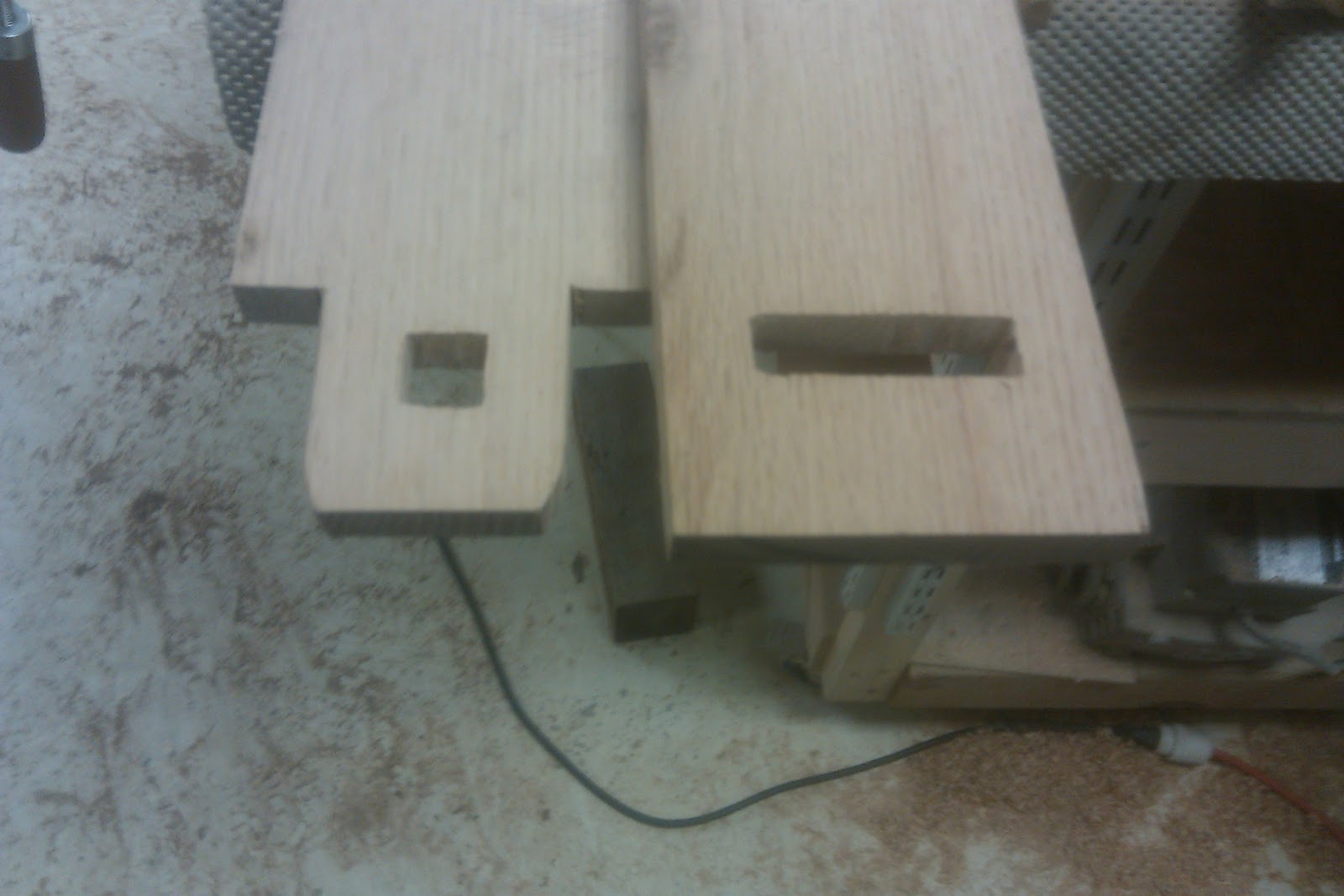
For the shorter end boards you need a mortise near each end for the long boards to fit into. On one end measure in down 1”and mark across the board then measure down another ¾” and make another mark. Measure in from each side 1”. This should give you a rectangle ¾”x 3”. On the other end measure down 2” and then repeat the rest of the step above. Once all of the mortises are laid out I used a dedicated mortiser to remove the material. You could do the same thing by drilling holes near the corners then use a jig saw (I wish I had) which would have worked better than the junky mortiser I used.
Once all of the mortise and tenons are cut I needed to true them and fit each part together. This is done with a set of woodworker’s files and rasps. Decide which side is up on the long boards and always test your fit with the same tenon going into the same mortise. I numbered mine and marked the top to be sure I didn’t mix them up. On the short boards the mortise that is 1” from the end is the bottom and will have the foot attached later.


After fitting the pieces I picked the walnut I was using for trim. Instead of drilling shallow holes into the bottom to accept the rod handles I decided to add a raised piece of trim measuring ¾” x ¾” along the front and back edge of the bottom shelf. These were cut long, glued then clamped in place to dry. Be sure the edges line up as best as you can to cut down on sanding later. But if they are off a bit sanding blends them so don’t worry too much, just get them as close as you can. After they dry I cut the trim to length using a Japanese trim saw. While these are drying you can work on the sides, feet and trim for the top.


I made the pattern for the feet using a scrap piece of wood but you could use cardboard. I drew the pattern on the scrap, cut it close on the band saw then finished it on the oscillating drum sander. This was used to transfer the shape to the ends of the feet. Use double sided tape to hold the feet together then cut the excess away on the band saw. Using the oscillating sander I sanded down to the line making the feet match. These are attached to the end boards using wooden dowels. Find the center of the side piece and the center of the foot. Measure out from the center 1 ¾” toward the edge and drill a hole in the center of the board one size larger than the dowel. I used the bit to enlarge and taper the hole to give me some wiggle room in making them fit. Cut the dowels to length, add glue and attach the foot to the side. I used bar clamps to draw everything together. Again try to get things as even as you can to cut down on sanding.


I wanted a piece of walnut trim on the top of the ends to give them a finished look. I cut two pieces of walnut 5 ¼” long x ¾” square. I glued these to the tops, clamping them with bar clamps till dry. After they were dried I drew a radius on the top corners and I will sand to the line, giving them a nice curve instead of sharp corners.
To hold everything together you need 4 wedges, which I made out of a scrap of walnut. I cut them into 1” squares 2 ½” long then shaped them on the belt/disc sander. You need to add a taper to one side so that as it tightens it will push everything together. Take your time and test fit these frequently to be sure you get a good fit and don’t take off too much material. This piece really needs to be made from hardwood even if you chose to work with pine for the rest of the boards.


I was planning to finish this in one post but things got in the way. Here is a shot of the almost finished piece. I still need to drill holes for the rods, cut slots back to the holes, make walnut pegs to hold rods in place, finish sanding and add finish. This sounds like a lot but it really isn’t but other things have kept me from getting it done. I will get it finished up in a few days and post the last few steps and pictures of the finished piece.

Overlooked, River Silver
I grew up in Nashville, actually , East Nashville, which let me have access to some of the large TVA lakes and dams that dot the state. Just outside of Nashville is Old Hickory and Percy Priest, both have been favorite stomping grounds since we were kids. Priest is a draw down impoundment, turbines below the dam only run a few weeks a year to pull the lake down to winter pool or if we have a lot of rain, enough to hold the level. Old Hickory is different, it runs 24 hours a day, providing electrical energy to the grid, the more power needed the more of it’s twelve turbines they run. This provides good fishing on both sides of the river just about whenever you feel the need to head that way. Rockfish (stripers), hybrids, catfish, sauger and a list of panfish are caught below the dam either from boats or the two catwalks, one on either side, built for fishermen.
 Percy Preist in the summer. You might call this limited fishing opportunities.
I loaded up the boat to try for rockfish and cats one warm Saturday afternoon during mid summer. No wind and a partly cloudy sky promised a good evening on the river. I got to the ramp at Old Hickory, which I hate, it is extremely steep, long and narrow, got the boat launched, then headed upstream to the dam. The turbines are on the left side going upstream with flood gates in the center and the lock on the right. Underwater downstream of the flood gates are large rock piles that hold fish but steal terminal tackle at an astounding rate. There is a good current break where the turbines meet the flood gates, this break flows down the edge of these rock piles at mid river, this is where rockfish and cats cruise.
 Gary Hanson with a nice rockfish from Alabama. One of the fish we were after. Photo credit: Gary Hanson
 I was at the far end of the turbines. This view is from the fishermens' catwalk.
I pulled up to the face of the dam where the current break begins, we rigged heavy jigs and started casting into water flowing fast from the turbines. This provided good exercise but no strikes so I started wondering what I needed to change. I was tied to the corner of the dam in an eddy and noticed something running shad along the front of the flood gates in the slack current. Stripe (white bass) do this all the time and I sure don’t mind catching them, I’ve caught big stripe in this spot, so my decision was made.
I rigged a 6 ½ foot spinning rod with a #7 Countdown Rapala, another with a white ¼ oz Roostertail and started casting where I could see strikes. It only took a couple of casts for the rod to bend to the handle and a fight to start. After a few seconds a silver rocket came out of the river, back arched, mouth open, twisting and throwing spray. My fishing partner throws into the same spot and gets the same results, now two skipjacks are putting on a show like miniature tarpon, at times several feet in the air. Landing a 2 pound skipjack, I smiled, forgot about what I had come to the river to catch, made another cast and held on.
 Tennessee tarpon. Great fighters and almost completely overlooked.
Skipjack are called Tennessee tarpon around here and have earned their name. Besides being some of the best live or dead bait, they are an absolute blast to catch. Every evening during warmer weather they move along the dam and riprap assaulting baitfish. This particular evening they were moving, along with schools of stripe, against the dam face keeping shad pushed to the surface. All along the walls shad were jumping out of the water trying to shake the predators. All I needed to do was follow along with my trolling motor, casting past the splashes, then retrieving through the school. Very few casts went without a strike.
We had hit after hit from stripe and skips, spinning rods bent, reels screaming from the strain as good fish stripped line. We followed schools along concrete surfaces watching shad as they flew out of the river, onto the sloped face, flopping as they went from frying pan to fire. We weren’t the only ones that knew about this evening ritual, black crowned night herons and great blue herons, stood along the water’s edge waiting for shad to appear. They happily speared a shad supper they didn’t have to work for. The action continued, larger fish began showing up as light levels dropped. As bigger fish came in they got more aggressive, several times we had two large skipjack on one bait, straining the poor light rods and eight pound test we were using.
As dusk set in the action slowed, so under the sodium lights illuminating the river from the dam, we rigged up for catfish with a fresh stock of bait. With a live well full of stripe, any cats would be bonus fish. Darkness came and we drifted the current break with a breeze created by water from under the dam rushing by cooling us and keeping the skeeters at bay. We did manage to catch a couple of good cats that night, one blue going about 8 pounds, before packing it in. If we hadn’t seen a cat that night it wouldn’t have mattered, stripe and skipjack had given us a great time.
When I lived close enough to run out in the afternoons many times I went just for the skipjack. I would fish the lock side of the river since it has less current, waiting for the schools to start running the banks late in the day. I use several baits to catch skips, jig and twister combos, Roostertails, #7 Countdowns, anything 1 ½ to 2 inches in length mimicking a shad works. 6 ½ to 7 ½ foot spinning rods with 8 to 10 pound test is all you need. These are fish that so many people never fish for and I love to catch, they are incredible fighters and provide bait for my catfishing trips.
Skipjacks are simply one of the best baits for cats and stripers, either live, cut into chunks or whole, they are great and free. I get as many as I can and freeze them, guts in one bag and fillets in another for later use. Most people use a cast net and it works like a champ. There are several guys from Viet Nam and Laos I’ve met that net big numbers of skips and big gizzard shad to eat. They cut the bellies out leaving a really nice fish which they stack into boxes, the bellies and innards go into a bucket. They will gladly give you the insides which saves me time on those days if I just want to catfish and they are at the river.
Keeping with my theme of having fun outdoors, not making it work like tournament fishing or big time deer management, I have no problem fishing for species most people turn their nose up to if you mention fishing for them. I am out to enjoy whatever time I get plus I need skipjack to help fill my freezer and those of needy families I bring food during the year. In many areas skipjack are plentiful, almost completely overlooked, great bait and better fighters. Do I even need to say it?
Go out and give these guys a try. What a fun way to spend a summer afternoon, rod bent double, drag screaming, silver in the air throwing spray and a smile on your face.

I loaded up the boat to try for rockfish and cats one warm Saturday afternoon during mid summer. No wind and a partly cloudy sky promised a good evening on the river. I got to the ramp at Old Hickory, which I hate, it is extremely steep, long and narrow, got the boat launched, then headed upstream to the dam. The turbines are on the left side going upstream with flood gates in the center and the lock on the right. Underwater downstream of the flood gates are large rock piles that hold fish but steal terminal tackle at an astounding rate. There is a good current break where the turbines meet the flood gates, this break flows down the edge of these rock piles at mid river, this is where rockfish and cats cruise.


I pulled up to the face of the dam where the current break begins, we rigged heavy jigs and started casting into water flowing fast from the turbines. This provided good exercise but no strikes so I started wondering what I needed to change. I was tied to the corner of the dam in an eddy and noticed something running shad along the front of the flood gates in the slack current. Stripe (white bass) do this all the time and I sure don’t mind catching them, I’ve caught big stripe in this spot, so my decision was made.
I rigged a 6 ½ foot spinning rod with a #7 Countdown Rapala, another with a white ¼ oz Roostertail and started casting where I could see strikes. It only took a couple of casts for the rod to bend to the handle and a fight to start. After a few seconds a silver rocket came out of the river, back arched, mouth open, twisting and throwing spray. My fishing partner throws into the same spot and gets the same results, now two skipjacks are putting on a show like miniature tarpon, at times several feet in the air. Landing a 2 pound skipjack, I smiled, forgot about what I had come to the river to catch, made another cast and held on.

Skipjack are called Tennessee tarpon around here and have earned their name. Besides being some of the best live or dead bait, they are an absolute blast to catch. Every evening during warmer weather they move along the dam and riprap assaulting baitfish. This particular evening they were moving, along with schools of stripe, against the dam face keeping shad pushed to the surface. All along the walls shad were jumping out of the water trying to shake the predators. All I needed to do was follow along with my trolling motor, casting past the splashes, then retrieving through the school. Very few casts went without a strike.
We had hit after hit from stripe and skips, spinning rods bent, reels screaming from the strain as good fish stripped line. We followed schools along concrete surfaces watching shad as they flew out of the river, onto the sloped face, flopping as they went from frying pan to fire. We weren’t the only ones that knew about this evening ritual, black crowned night herons and great blue herons, stood along the water’s edge waiting for shad to appear. They happily speared a shad supper they didn’t have to work for. The action continued, larger fish began showing up as light levels dropped. As bigger fish came in they got more aggressive, several times we had two large skipjack on one bait, straining the poor light rods and eight pound test we were using.
As dusk set in the action slowed, so under the sodium lights illuminating the river from the dam, we rigged up for catfish with a fresh stock of bait. With a live well full of stripe, any cats would be bonus fish. Darkness came and we drifted the current break with a breeze created by water from under the dam rushing by cooling us and keeping the skeeters at bay. We did manage to catch a couple of good cats that night, one blue going about 8 pounds, before packing it in. If we hadn’t seen a cat that night it wouldn’t have mattered, stripe and skipjack had given us a great time.
When I lived close enough to run out in the afternoons many times I went just for the skipjack. I would fish the lock side of the river since it has less current, waiting for the schools to start running the banks late in the day. I use several baits to catch skips, jig and twister combos, Roostertails, #7 Countdowns, anything 1 ½ to 2 inches in length mimicking a shad works. 6 ½ to 7 ½ foot spinning rods with 8 to 10 pound test is all you need. These are fish that so many people never fish for and I love to catch, they are incredible fighters and provide bait for my catfishing trips.
Skipjacks are simply one of the best baits for cats and stripers, either live, cut into chunks or whole, they are great and free. I get as many as I can and freeze them, guts in one bag and fillets in another for later use. Most people use a cast net and it works like a champ. There are several guys from Viet Nam and Laos I’ve met that net big numbers of skips and big gizzard shad to eat. They cut the bellies out leaving a really nice fish which they stack into boxes, the bellies and innards go into a bucket. They will gladly give you the insides which saves me time on those days if I just want to catfish and they are at the river.
Keeping with my theme of having fun outdoors, not making it work like tournament fishing or big time deer management, I have no problem fishing for species most people turn their nose up to if you mention fishing for them. I am out to enjoy whatever time I get plus I need skipjack to help fill my freezer and those of needy families I bring food during the year. In many areas skipjack are plentiful, almost completely overlooked, great bait and better fighters. Do I even need to say it?
Go out and give these guys a try. What a fun way to spend a summer afternoon, rod bent double, drag screaming, silver in the air throwing spray and a smile on your face.
Tuesday, January 18, 2011
Growing Local
I was taking with my friend ,Jim Cates, about a couple of things, one was deer hunting. Jim is not a deer hunter and was trying to understand how people could justify spending the time and money they do on food plots. I had to agree with a lot of what he had to say. Mainly that many people are taking this to extremes. I, being of poor means, don’t have the property or the money to invest in this part of game management. My counter to it was this created jobs, helped add money to the outdoor industry and helped provide for wildlife. He said he could see that and to each his own but that wasn’t how he would chose to hunt. It isn’t how I hunt either but I do use food plots and mineral licks to the small extent I can.
Jim gets to fish beautiful waters in east Tennessee for trout and like he said, all he has to do is step into the river. Getting set up to trout fish isn’t cheap but once you do you are mostly done. Deer hunting was like that but it is changing and some of it, not for the better for many of us. Would I like to go on a guided hunt on the Milk River or in Kansas? Yes I would. Is it going to happen? No. I don’t have $10,000 to $20,000 to pay for a hunt and if I did I would be going to Africa. Hunt and lease prices continue to go beyond the reach of most of us dragging the price of products along with them. This includes seeds, fertilizers and supplements.
I was thinking how this type of game management is affecting many hunters that, like me, don’t have much money. I would love to have huge acreage (own/lease) to plant and manage so I could finally take a buck that might go 130”. I never have even though I take a lot of deer, I have the does scared though. My reality is, I hunt small pieces of property, most don’t have a place to plant, I don’t have the rights to plant or have livestock. Where I can plant the spots are small and I do everything with very little equipment. Only twice have I even had access to a tractor. This is how I came up with ways to cut costs and support local businesses at the same time.
Most people plant food plots using commercially available products. They do work but aren’t cheap. These are bagged in amounts for plots from ¼ to several acres in size. The seeds used in these products are good but the problem is they use what I refer to as the shotgun mix when deciding which seed to use. To be fair, they need a product that will work from Texas to Michigan, from north Carolina to Montana. It must have something in it that will grow under a wide range of conditions but no matter what the packaging says, every type of seed will not grow everywhere. This mix has a variety of seeds that once spread out has something in it that will grow. The rest go to waste and while it does make some nice plots, you waste money by having seed types that don’t grow in your location. I can say this from experience since using these products is where I started.
As I tried a few different brands I decided I wanted seed that grew better where I was planting, there was too much in these that didn‘t work. So I went on a quest to figure out what to do. Back then I lived in Murfreesboro, while running errands I saw Hooper Supply just behind Cannonsburg Historic Village. I stopped in to ask if they had something I could plant and as I walked in the door knew I had found what I needed. There were hand printed signs listing seeds, pictures on the wall supplied by farmers and hunters, folks hanging around talking. From seeds for the farm to, can you believe it, a whole board devoted to deer hunters, it was listed right up there on the wall. On it was a list of seeds meant to work in our area. I didn’t see one listed that was the magic bullet of seeds guaranteed to grow everywhere. I looked around, there wasn’t one bag of mega mix, works anywhere, food plot seeds.
 Note my high dollar huntin' rig parked out front.
 This is Angie, she runs things and keeps the boys working there straight.
Bruce, introduced himself asking what I needed, he took the time to talk to me, telling me deer stories and asking what I wanted my plot to do. We talked about the place I was planting, fertilizer and what seed would work best with the weather conditions we were expecting. He told me they did not carry premixed bags but blended seed for each person’s needs. He would talk to guys, like me, that were new then provide specific mixes for them. Unlike some of the box stores or outdoors mega stores, the seed here was fresh not held over from last year. Some of the big stores are careful about this, others not so much, here it wasn’t a problem. I made my picks, got loaded up and when I was leaving Bruce asked if I would bring in some pictures of my plot. I said sure and headed out to the woods.
 Look close my plot is in the top right corner. Look real close and you can find pics of albino deer.
That first plot was a success for the plants. The turkeys and deer used it but I didn’t take one out of it. I did manage to miss a couple of turkeys with my bow. I shot a couple of deer not far from the plot but the best thing was what I learned from it. That little plot taught me what I could do with a limited budget and seeds targeted to my area. It grew into a beautiful spot and the pictures I took are still on the board at Hooper’s. I still use what I learned there every time I put out one of my tiny spots.
The other thing is the use of supplements such as mineral licks. I have used the major brand for many years, paying an average of $1.00 a pound for the natural blocks. During one stop at the Co-Op one of the guys there asked why I was buying that brand. I said it was because I wanted to use a product with no fillers to get my monies worth. He told me to come to the back of the shop where the feed is kept. When we got there he pulls out a fifty pound block used for cattle and says look at the label. Sure enough, it contained the same things as what I had been using. The difference, $6.50 for a fifty pound block, not $15.00 for 14-15 pounds. For the price of one 15 pound block I could now put out 100 pounds. I take the blocks, whack ‘em with a big hammer, so I can spread it out in several spots.
 The food plot board. Notice it only has one bag of mixed seed. Here you buy from bulk, no need to pay for packing and big time ads.
What I learned is to stop paying for packaging and advertising. I now buy products that are fresher, cheaper and work better for my needs. I can buy seed for a fraction of the cost and get just what I need for the time of year and soil conditions. I have knowledgeable, local people to ask if something isn’t working and sometimes get invited to hunt a new spot by one of the farmers dropping by to pick up supplies.
I know many folks may not like the thought of products they use not being the best. Can’t blame someone for that. We all want to think our money is wisely spent. Many times that might not be the case. If you take a look you might find the same problems I did and be able to apply the same solutions. If you plant large areas and your seed cost drops, think of how much more you can do. My money now goes farther, products I purchase work better and I help my community by supporting local business.
Jim gets to fish beautiful waters in east Tennessee for trout and like he said, all he has to do is step into the river. Getting set up to trout fish isn’t cheap but once you do you are mostly done. Deer hunting was like that but it is changing and some of it, not for the better for many of us. Would I like to go on a guided hunt on the Milk River or in Kansas? Yes I would. Is it going to happen? No. I don’t have $10,000 to $20,000 to pay for a hunt and if I did I would be going to Africa. Hunt and lease prices continue to go beyond the reach of most of us dragging the price of products along with them. This includes seeds, fertilizers and supplements.
I was thinking how this type of game management is affecting many hunters that, like me, don’t have much money. I would love to have huge acreage (own/lease) to plant and manage so I could finally take a buck that might go 130”. I never have even though I take a lot of deer, I have the does scared though. My reality is, I hunt small pieces of property, most don’t have a place to plant, I don’t have the rights to plant or have livestock. Where I can plant the spots are small and I do everything with very little equipment. Only twice have I even had access to a tractor. This is how I came up with ways to cut costs and support local businesses at the same time.
Most people plant food plots using commercially available products. They do work but aren’t cheap. These are bagged in amounts for plots from ¼ to several acres in size. The seeds used in these products are good but the problem is they use what I refer to as the shotgun mix when deciding which seed to use. To be fair, they need a product that will work from Texas to Michigan, from north Carolina to Montana. It must have something in it that will grow under a wide range of conditions but no matter what the packaging says, every type of seed will not grow everywhere. This mix has a variety of seeds that once spread out has something in it that will grow. The rest go to waste and while it does make some nice plots, you waste money by having seed types that don’t grow in your location. I can say this from experience since using these products is where I started.
As I tried a few different brands I decided I wanted seed that grew better where I was planting, there was too much in these that didn‘t work. So I went on a quest to figure out what to do. Back then I lived in Murfreesboro, while running errands I saw Hooper Supply just behind Cannonsburg Historic Village. I stopped in to ask if they had something I could plant and as I walked in the door knew I had found what I needed. There were hand printed signs listing seeds, pictures on the wall supplied by farmers and hunters, folks hanging around talking. From seeds for the farm to, can you believe it, a whole board devoted to deer hunters, it was listed right up there on the wall. On it was a list of seeds meant to work in our area. I didn’t see one listed that was the magic bullet of seeds guaranteed to grow everywhere. I looked around, there wasn’t one bag of mega mix, works anywhere, food plot seeds.


Bruce, introduced himself asking what I needed, he took the time to talk to me, telling me deer stories and asking what I wanted my plot to do. We talked about the place I was planting, fertilizer and what seed would work best with the weather conditions we were expecting. He told me they did not carry premixed bags but blended seed for each person’s needs. He would talk to guys, like me, that were new then provide specific mixes for them. Unlike some of the box stores or outdoors mega stores, the seed here was fresh not held over from last year. Some of the big stores are careful about this, others not so much, here it wasn’t a problem. I made my picks, got loaded up and when I was leaving Bruce asked if I would bring in some pictures of my plot. I said sure and headed out to the woods.

That first plot was a success for the plants. The turkeys and deer used it but I didn’t take one out of it. I did manage to miss a couple of turkeys with my bow. I shot a couple of deer not far from the plot but the best thing was what I learned from it. That little plot taught me what I could do with a limited budget and seeds targeted to my area. It grew into a beautiful spot and the pictures I took are still on the board at Hooper’s. I still use what I learned there every time I put out one of my tiny spots.
The other thing is the use of supplements such as mineral licks. I have used the major brand for many years, paying an average of $1.00 a pound for the natural blocks. During one stop at the Co-Op one of the guys there asked why I was buying that brand. I said it was because I wanted to use a product with no fillers to get my monies worth. He told me to come to the back of the shop where the feed is kept. When we got there he pulls out a fifty pound block used for cattle and says look at the label. Sure enough, it contained the same things as what I had been using. The difference, $6.50 for a fifty pound block, not $15.00 for 14-15 pounds. For the price of one 15 pound block I could now put out 100 pounds. I take the blocks, whack ‘em with a big hammer, so I can spread it out in several spots.

What I learned is to stop paying for packaging and advertising. I now buy products that are fresher, cheaper and work better for my needs. I can buy seed for a fraction of the cost and get just what I need for the time of year and soil conditions. I have knowledgeable, local people to ask if something isn’t working and sometimes get invited to hunt a new spot by one of the farmers dropping by to pick up supplies.
I know many folks may not like the thought of products they use not being the best. Can’t blame someone for that. We all want to think our money is wisely spent. Many times that might not be the case. If you take a look you might find the same problems I did and be able to apply the same solutions. If you plant large areas and your seed cost drops, think of how much more you can do. My money now goes farther, products I purchase work better and I help my community by supporting local business.
Sunday, January 16, 2011
Places, a Tour
I thought I would share a few more places I have been over the years. Each with great memories. Some I visited once, others I return to again and again. Hope you enjoy a little tour around middle Tennessee.
 This was my little corner of the woods in "Airborne" and "Of Firsts and Memories". I got my first muzzle loader doe, first bow buck and first batch of air rifle squirrels in this exact spot. Rutherford County.

This was my first food plot. The pictures of the whole thing still hang in the local feed store. The little corner of the woods is just 60 yards off the right hand side of this picture.
 Early season crappie fishing on Percy Priest with my buddy, Jimmy, from "Kentuckys on the Wire".This is just down from Fate Sanders marina.

 Two views from a stand that had a terrifying climb into a massive old ceder tree. Sadly it was lost in a storm. Huge tree, huge stand and a beautiful view. Humphreys county.
 Finally, a spot two minutes from my house. This is a 200 acre farm that I sometimes get to hunt. This is a spot the turkeys use for a strutting ground. Bedford county.


Subscribe to:
Posts (Atom)

About Me
- Tommy Ellis
- Born and raised in middle Tennessee.I'm a working wildlife and landscape artist specializing in watercolors. Now making cedar lures and custom turkey calls.


